|
Annual
Report - 2021
REPORT OF THE NEW YORK STATE AVIAN RECORDS COMMITTEE
FOR 2021
The New York State Avian Records Committee (hereafter “NYSARC” or the “Committee”) evaluated 68 formal submissions involving 43 occurrences of New York State review species from 2021. There were no formal submissions received of New York State review species from previous years. Reports were received from across the state, with 20 of the 62 counties represented (there were no reports from the pelagic zone). The number of reports accompanied by photographs remains high and naturally benefits the value of the archive. The Committee wishes to remind readers that reports submitted to listservs, local bird clubs, rare bird alerts (RBAs) and even the Kingbird Regional Editors are not necessarily passed along to NYSARC. Doing so, therefore, remains the responsibility of the observer(s). The best way to ensure a rarity is reviewed by NYSARC is to submit a formal report to the Committee, which would include written details and possibly photographs or audio recordings. Submitting an acceptable report to eBird also works, although NYSARC review of eBird reports may lag slightly behind reviews of formal submissions. As is well-known by now, the use of the Internet and mobile phones has had a very positive impact on the timely dissemination of rare bird sightings and has made it easier for birders to locate rarities found by others. The Committee has always held that receipt of multiple independent reports provides a much fuller documentation of the sighting and can in some cases increase the likelihood of acceptance. We therefore urge ALL observers, not just the finder, to submit written reports and/or photographs. The names of the 51 contributors that submitted materials for the formal submissions (written reports, photographs, video and audio recordings, and sketches) are listed alongside accepted reports and again at the end of the formal submissions section of this document. Where possible, the name(s) of the original finder(s) is (are) included in the narratives. Production of this Annual Report is a team effort. In addition to the contributors referenced above, some Kingbird Regional Editors and eBird reviewers have helped observers to prepare and submit documentation.
HOW TO SUBMIT REPORTS
Advice on how to prepare and submit a report is provided on the NYSARC pages within the New York State Ornithological Association (NYSOA) web site: http://nybirds.org/NYSARC/index.htm. Although it may go without saying that photographs and/or audio recordings of the reported bird(s) can be vitally important to getting a record accepted by the Committee, it cannot be emphasized enough that a thorough written description of the bird(s) and the circumstances of the observation, as well as other pertinent details, can also propel a record to acceptance. Unfortunately, eBird reports are frequently very short on details and when those reports also lack hard evidence, such as photos or audio recordings, it becomes difficult for the Committee to accept them. This highlights an important distinction between NYSARC and eBird. Some eBird reports are accepted by eBird reviewers in large part because the observer is considered experienced.
While NYSARC may consider the observer’s experience, we require accepted records to have archived documentation that can be reviewed by anyone in the future. As such, some reports from very experienced observers that have few or no substantial details and which were accepted by eBird reviewers, will not be accepted by NYSARC.
Also on the NYSARC pages is a list of species requested for review by NYSARC (The Review List) as well as illustrated copies of previous annual reports. The Committee is very grateful to Carena Pooth (NYSOA Web Master) for updating and continuously improving the NYSARC web site. An on-line reporting form allows observers to compose a written report and attach up to three digital image files (maximum size 7 MB per photo). Documentation (written reports, photographs, audio recordings) and any other correspondence for the Committee can also be sent via email to the NYSARC Secretary, Gary Chapin, at: nysarc44@nybirds.org. As a last resort, you can also use regular mail to get your report to Gary:
Gary Chapin, 125 Pine Springs Drive, Ticonderoga, NY 12883
HIGHLIGHTS
New York State has a long history of ornithological study within its boundaries. A number of significant works specific to birds in New York illustrate this point: DeKay (1844), Eaton (1910, 1914), Reilly and Parkes (1959), Bull (1974), Levine (1998), as well as numerous regional tomes. It is well known that such ornithological luminaries as Alexander Wilson, John James Audubon, Arthur A. Allen, and Roger Tory Peterson plied the woods, fields, and waters of the state, contributing immensely to our understanding of the birds that occur here. The NYSARC has been in existence since 1977, no doubt helping to fuel additional interest and field study during the ensuing decades. With such a long and rich history of bird study, one might assume that new additions to the state checklist would now be very infrequent. But looking at NYSARC’s annual reports over the past two decades shows that these additions are not slowing down, with an average of more than two new species every year. Even in light of this, however, five additions in 2021 would have to be considered extraordinary. The reason for this fairly steady and at times rapid increase likely has something to do with our warming climate but one would have to delve into the details of each species to know this with any degree of certainty. The five species added to the state list in 2021 were Tundra Bean-Goose, Snowy Plover, Ferruginous Hawk, Gray-breasted Martin, and Violet-green Swallow. We urge the reader to check out NYSARC’s article that details these exciting occurrences, along with additional first state records (see Healy 2024). At the end of 2021, the state list stood at 502 species.
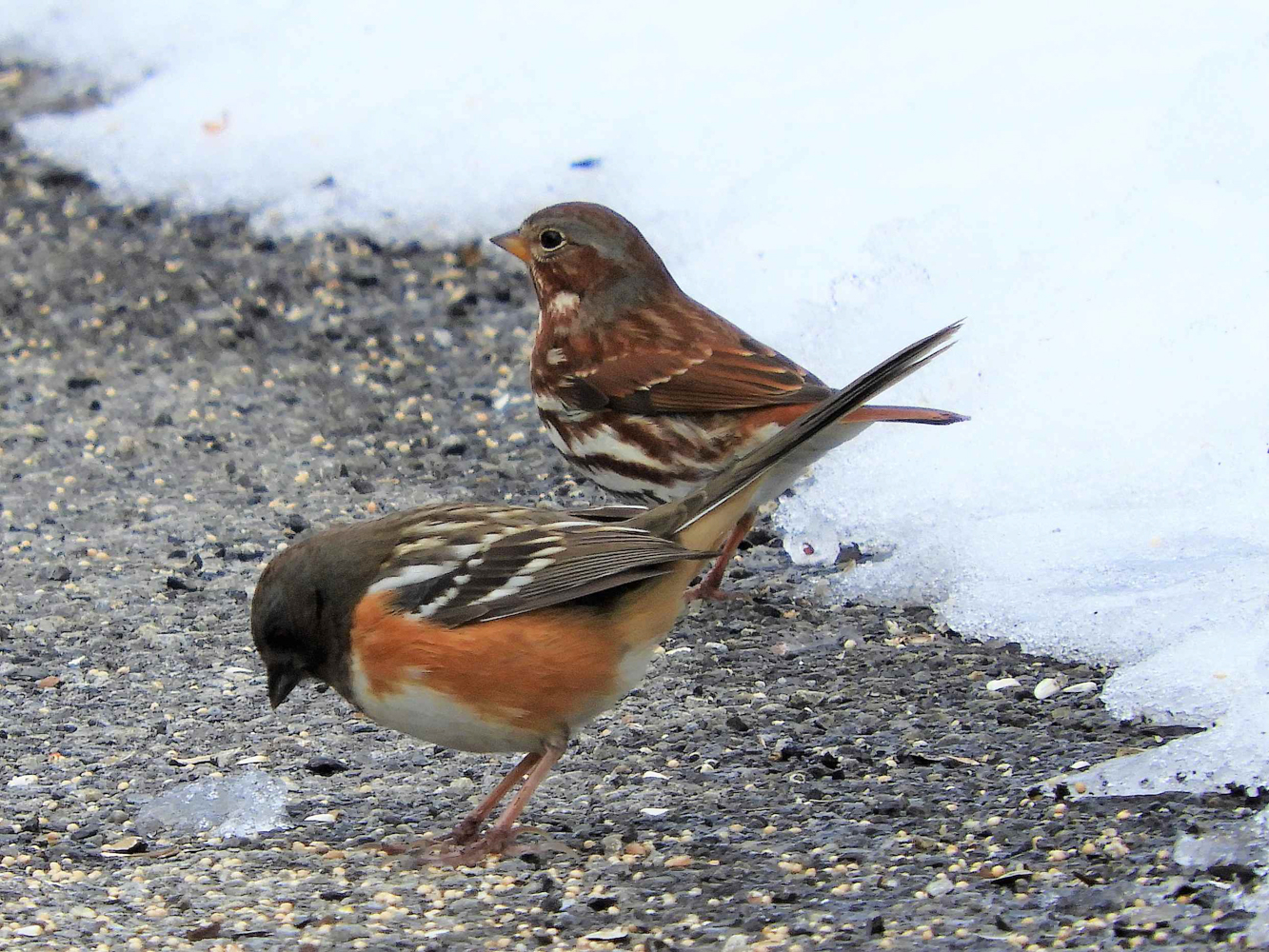
Another great discovery was a Common Ringed Plover, the first inland record for New York which was found by a birder who was on a successful chase to see the Snowy Plover at Sandy Pond on Lake Ontario. This provided just the third record for the state. Only eleven months after the first one, a Tropical Kingbird on Staten Island was the second record for New York, while a Spotted Towhee on Long Island was the second record that has been reviewed and accepted by the
Committee with both of those occurring within fourteen months. A remarkable ten records of Roseate Spoonbill in 2021, with only two prior state records, and 12 records of Brown Booby, are just two more examples of the surprising and rapidly changing state of the birds in New York.
COMMITTEE NEWS
The 2021 annual meeting was held via Zoom on 25 September 2022. Note that the annual meeting year refers to the latest reports reviewed at that meeting. For the first time in memory, the formal submissions were finalized prior to the meeting, leaving only some eBird records for further discussion and voting. Due to the passing of Shane Blodgett, there were only six Committee members voting on the formal submissions for this report. In addition, our secretary, Gary Chapin, once again showed what a valuable team member he is by voting in the initial round of eBird review in place of Shane. This, of course, was in addition to his regular duties, which are substantial. Subsequent rounds of review of eBird records and all formal submissions were voted on by only six members. The terms of Patricia Lindsay and Shawn Billerman expired at the end of 2022 and both graciously agreed to stay on the Committee for another term.
The NYSARC remains caught up on formal submissions, reviewing reports within a year after the close of the previous year. At the time of this writing (September 2024), we have now reviewed 2019-2023 eBird records concurrently with formal submissions from the same year. We have also reviewed accepted eBird records from 2010 through 2018. Note that here we are referring to records accepted by an eBird reviewer. We do not review records that are not accepted in eBird.
As eBird was launched in 2002, we only have eight more years to evaluate. Of course, eBird now has many records from years prior to its launch. However, documentation in eBird for most of these older records is very limited, so the Committee will have to decide if it is worth the effort to compile and review these as well.
Since the annual reports have been lagging behind the reviews by a few years, there is a discrepancy between the current Committee members and those listed at the end of this annual report. The current members of the Committee, as of February 2025, are Michael McBrien (Chair), Gary Chapin (Secretary), Tom Burke, Patricia Lindsay, Jay McGowan, Shawn Billerman, Tim Healy, and Mike Cooper. The lead authors of this report are Willie D’Anna and Gary Chapin, with Mike McBrien preparing much of the Trumpeter Swan account. Even though Willie is currently off the Committee, he has agreed to continue working on the annual reports until they are caught up.
THE REVIEW LIST
Prior to the September 2022 meeting, a subcommittee of NYSARC was formed to look into ways of standardizing which species are added to or removed from the review list for the entire state, as well as for upstate and downstate regions, the Adirondacks, and the pelagic zone. This subcommittee was headed up by Michael McBrien and included Patricia Lindsay, Gary Chapin, and Willie D’Anna. Up until this time, species were added or removed from the review list using a rather informal procedure: when a Committee member brought up the species for consideration, there would be a discussion and a decision made based upon a general consensus of the members. Although this has generally worked pretty well, there have been occasions when a species was added to the review list, perhaps prematurely, only to be removed a few years later when there was a spate of records. The opposite has occurred as well, with a species being taken off the review list, only to go back on a few years later after records tapered off. Desiring a more consistent approach, the subcommittee was formed and began to look into how this has been done in other states, provinces, and countries. The preliminary findings of the subcommittee and some proposed methods were discussed at the September 2022 meeting. Then, at the 25 June 2023 interim meeting, NYSARC agreed upon a formal procedure for removing a species from the review list, as described here. If either of the following two criteria is met, a species’ review status will be reviewed, but the species will not be taken off of the review list automatically:
- A species can be considered for removal from the NYSARC Review List if over a 20 year period there have been 30 accepted records statewide or 20 accepted records in a region, e.g., Upstate (U), Downstate (D), Adirondacks (A), or the Pelagic Zone (P).
- Additionally, a species can be considered for removal from the NYSARC Review List if over a 10 year period there have been 20 accepted records statewide or 15 accepted records in a region (e.g., Upstate, Downstate, Adirondacks, or the Pelagic Zone).
A formal procedure for adding a species to the review list has not yet been finalized. Prior to adopting the new procedure for removing a species, there were some changes to the review list made at the 6 March 2022 interim meeting:
Tufted Duck – changed from U to D (documentation is required for sightings in downstate regions)
Band-rumped Storm-Petrel – changed from N to P (documentation is required for sightings outside of the pelagic zone)
Northern Fulmar – changed from U to P (documentation is required for sightings outside of the pelagic zone)
Boreal Chickadee – changed from no designation to A (documentation is required for sightings outside of the Adirondacks)
(Note: “N” means documentation is required for sightings anywhere within the state.)
The change in status of Tufted Duck is particularly interesting, as it is now expected in upstate areas but has become much scarcer downstate. Also, it was noted that Boreal Chickadee was listed on the checklist as not requiring
documentation for occurrences anywhere in the state. This was an error of omission. We corrected this and changed its designation to “A”.
Utilizing the new procedure adopted at the 25 June 2023 interim meeting, 20 changes to the review list were made at NYSARC’s 19 November 2023 meeting. Along with 17 species added to the review list by virtue of first NYS records 2021-2023 and the split of Scopoli’s Shearwater, we suspect that these changes to the review list are the most extensive that have been made since NYSARC was first formed in 1977. All of these were published in The Kingbird Volume 74, Number 3, pages 236-237.
Not only does this suggest how rapidly changes in bird status are happening within New York in the present day, it also reflects upon the remarkable influence of eBird. Prior to eBird, the number of reviews that would come to the Committee was only a fraction of what it is presently, now that accepted eBird records review is also conducted by NYSARC. This tremendous increase in the volume of records that are reviewed and accepted provides a much more informed picture of bird status for those species on the review list and, as a result, a better understanding of where we should focus our efforts.
2021 Formal Submissions Accepted
Black-bellied Whistling-Duck (Dendrocygnaautumnalis)
2021-17-A/B One, Jamaica Bay Wildlife Refuge, Queens, 11, 13, 15 Jul (David Gillen, Peter Paul, ph D. Gillen, P. Paul). eBird 11, 13-16, 18, 19, 21-28, 30, 31 Jul, 1-5, 9, 10, 12-
21, 27, 29, 30 Aug
2021-25-A One, Myers Point, Tompkins, 15 Aug (Duane Otto, ph D. Otto, Rita Otto). eBird 15 Aug
Since the first record of this species to be voted on and accepted by NYSARC, in 2010, it has been found in the state every year but two. This is similar to another species of waterfowl that has become nearly annual since it first showed in the state, Pink-footed Goose. The factors driving these expansions, however, are completely different, with this species pushing north from the southern US and Central America, while the goose is moving west from Europe. Although this duck sometimes occurs in flocks, this year’s records were of singles, one at Jamaica Bay Wildlife Refuge, found by Peter Paul, and another at Myer’s Point on Cayuga Lake, found by Duane Otto. Four eBird records from 2021 were also accepted, including two each from Seneca and Suffolk Counties. See the “2021 eBird Records Automatically Accepted by NYSARC” below.
 Tundra Bean-Goose
photo
© Gregg Recer
Tundra Bean-Goose
photo
© Gregg Recer
(click photo to enlarge)
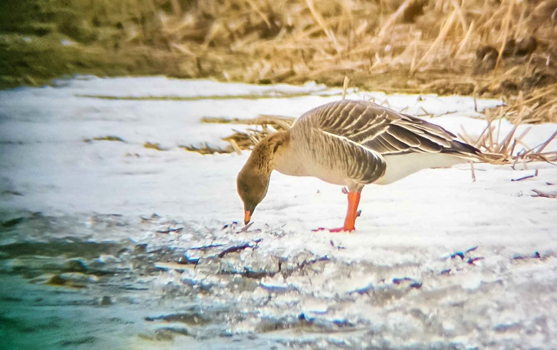
Tundra Bean-Goose (Anser serrirostris)
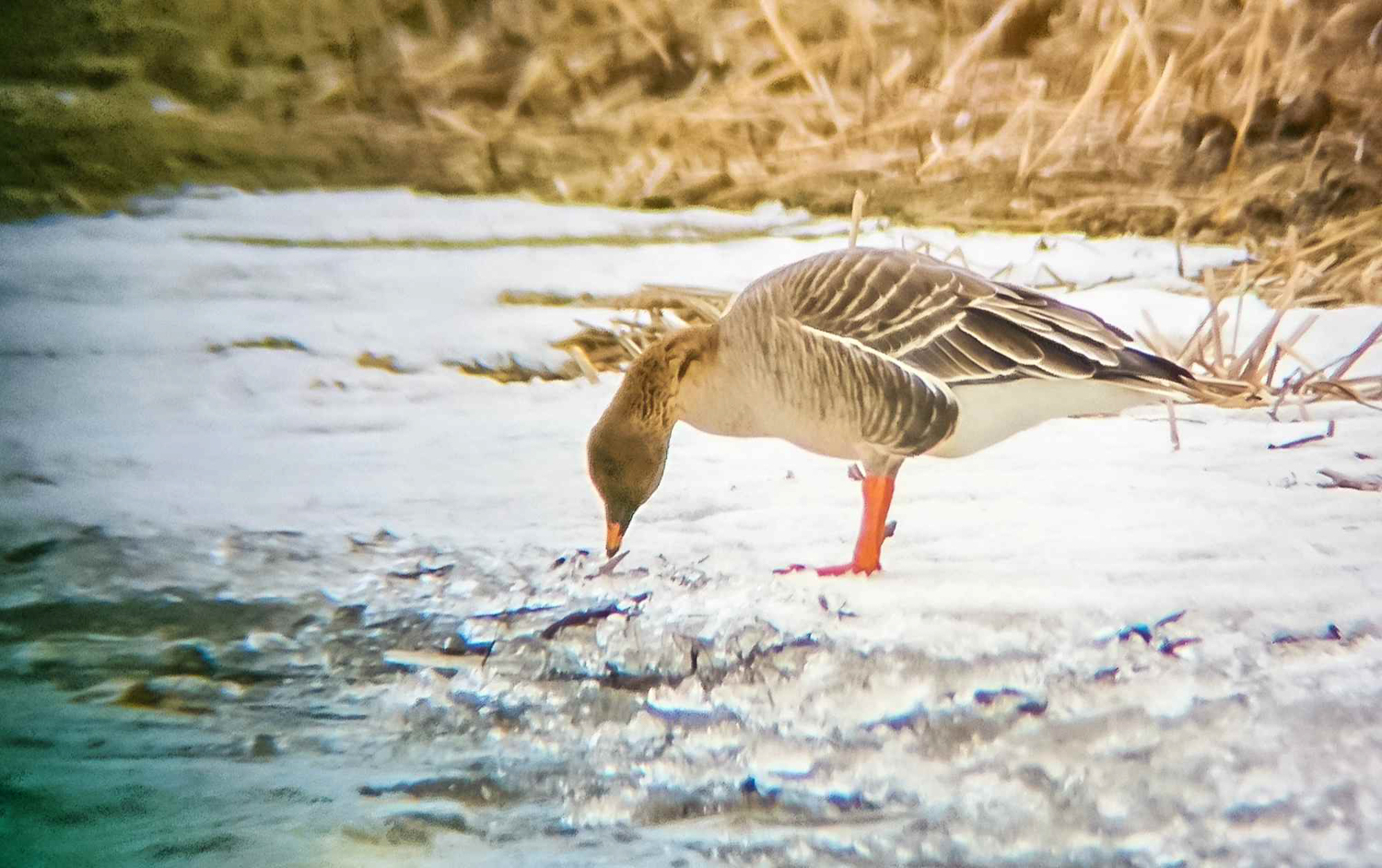
2021-9-A/B One, Saratoga Lake State Marine Park/Stillwater, Saratoga, 14, 16 Mar (Gregg Recer, Gary Chapin, ph G. Recer, G. Chapin, Eric Tepper). eBird 12 Mar (Rensselaer), 14, 16 Mar (Saratoga)
This first state record was discovered by David DiSiena in Rensselaer County and quite understandably, was initially identified as a Pink-footed Goose, a very similar species and one that has occurred many times in New York. Two days later, Cathy Graichen and Gregg Recer rediscovered the bird less than ten miles from the original location and were able to obtain better photos, which confirmed
the identification as a Tundra Bean-Goose. For a full account of this record, see Healy (2024).
Barnacle Goose (Branta leucopsis)
2021-34-A/B One, Cobleskill Reservoir, Schoharie, 6 Oct (David W. Harrison, Marianne Friers, ph D. Harrison, M. Friers). eBird 6 Oct
This Barnacle Goose, discovered by David Harrison and Mark Fitzsimmons, provided a first record for Schoharie County (NYSARC Online Database, eBird Jul 2024). It was only seen on the one day. Two additional records were accepted from eBird, one from Franklin County and one from Seneca County. See the “2021 eBird Records Automatically Accepted by NYSARC”, further on in this report.
 Western Grebe
photo
© Joshua Malbin
Western Grebe
photo
© Joshua Malbin
(click photo to enlarge)
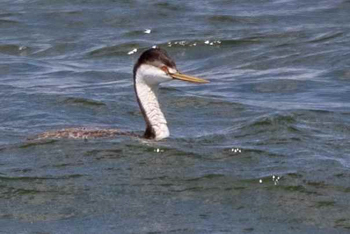
Western Grebe (Aechmophorus occidentalis)
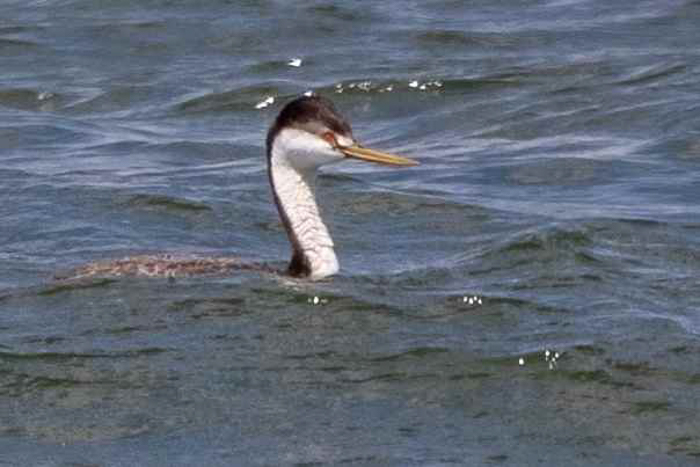
2021-12-A One, Coney Island, Kings, 11 May (Joshua Malbin, ph J. Malbin). eBird 11-14 May
A few observers of this bird at Coney Island noted what was thought to be an atypical amount of white on the face, as well as extra white in the flanks, and they cautiously wondered if this could indicate hybridization with Clark’s Grebe. Most of the Committee, however, felt that these features were within the range of variation for Western Grebe. Along with the characters that were typical for this species and unlike Clark’s Grebe, such as the bill color and broad dark neck stripe, the Committee felt that the record was well supported. The grebe was discovered by Anthony Ferino.
Rufous Hummingbird (Selasphorus rufus)
2021-21-A/B One, East Quogue, Suffolk, 5 Aug (Eileen Schwinn, Michael Higgiston, ph E. Schwinn). eBird 5 Aug
Susan Little wondered what the orange hummingbird was that was fighting with the Ruby-throateds in her yard, so she phoned her neighbor, Eileen Schwinn. Living just a few doors away, Eileen immediately went over and soon found the culprit—an adult male Rufous Hummingbird which was giving great views! Unfortunately, the bird was not reported again after this day.
Yellow Rail (Coturnicops noveboracensis)
2021-43-A One, Candor, Tioga, 8 Oct (Adam Troyer). eBird 8 Oct
Being an avid birder and living on a farm with diverse habitat in rural Tioga County seems like a recipe for uncovering rarities. Adam Troyer is such a birder and he has indeed turned up several rarities and even vagrants on his property (Troyer 2022). Certainly, this Yellow Rail would have to be near the top of the list of good birds that he has found but it was a bit unfortunate that the rail was just over the property line in his neighbor’s field, so it did not make it onto the yard list. The rail was first seen when it flushed in front of his mower. Troyer knew immediately by the dangling legs that it was likely a rail and when he saw the white patch on the bird’s secondaries, he realized that it was an incredibly rare Yellow Rail! Knowing that many birders would ache to see such a secretive and rare species, he organized what he called a rail rally that evening. After the first few attempts by the assembled group of about three dozen birders to flush the rail were unsuccessful, Troyer got on his mower thinking that this would be the only way. It was not too long before the rail flushed in front of the tractor and the area where it landed was soon surrounded by birders. Eventually, it was spotted but soon flew again. However, this time it dropped into a more open spot and everyone was afforded an extended view to the great delight of the birders. Although Troyer and others searched for the bird the following day, it was not seen again.
Snowy Plover (Charadrius nivosus)
2021-26-A/D One, Sandy Pond, Oswego, 13-16 Sep (Richard Guthrie, Sarah Forestiere, Shaibal S. Mitra, Dennis Anderson, ph R. Guthrie, S. Forestiere, S. Mitra). eBird 13-16 Sep
Piping Plover stewards Sarah Forestiere and Kennedy Sullivan were surveying for those birds when they discovered a Snowy Plover at Sandy Pond on the east end of Lake Ontario, providing a first state record. With at least eight records from Ontario, four New England states, Pennsylvania, and Ohio, New York’s first must be considered long overdue. For a full account of this record, see Healy (2024).
“Thayer’s” Iceland Gull (Larus glaucoides thayeri)
2021-4-A/B One, Beacon, Dutchess, 14 Jan (Barb Thomascall, Anthony Macchiarola, ph B. Thomascall, A. Macchiarola). eBird 14 Jan (Dutchess), 27 Jan (Orange)
2021-6-A One, Prospect Park, Kings, 5 Feb (Joshua Malbin, ph J. Malbin)
Although Thayer’s Gull and Iceland Gull were lumped under Larus glaucoides, Iceland Gull, in 2017, birders are still interested in identifying the Thayer’s subspecies in New York. Regular only along the Niagara River with occasional sightings elsewhere in upstate New York, this form is decidedly much rarer downstate. The identification remains difficult and although it may be less contentious now that it is no longer its own species, there is still the problem of intergrades. That is, individuals with genes from both the kumlieni (“Kumlien’s” Iceland Gull) and thayeri (“Thayer’s” Iceland Gull) subspecies can be difficult to separate from pure forms. The birds involved in these two records were both subadults, with the Beacon gull in juvenile plumage and the Prospect Park gull in first-basic plumage. Both were toward the dark end of the cline in features between the two subspecies, putting them solidly into the “Thayer’s” arena. The Beacon gull, which was along the Hudson River, was found by Anthony Macchiarola and separately by Barbara Thomascall a few minutes later. Joshua Malbin may have been the only observer of the Prospect Park bird, as there are no eBird records.
 Wood Stork
photo
© Susan Saunders
Wood Stork
photo
© Susan Saunders
(click photo to enlarge)
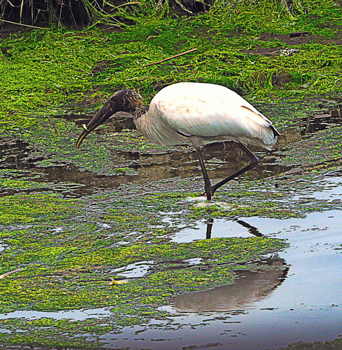
Wood Stork (Mycteria americana)
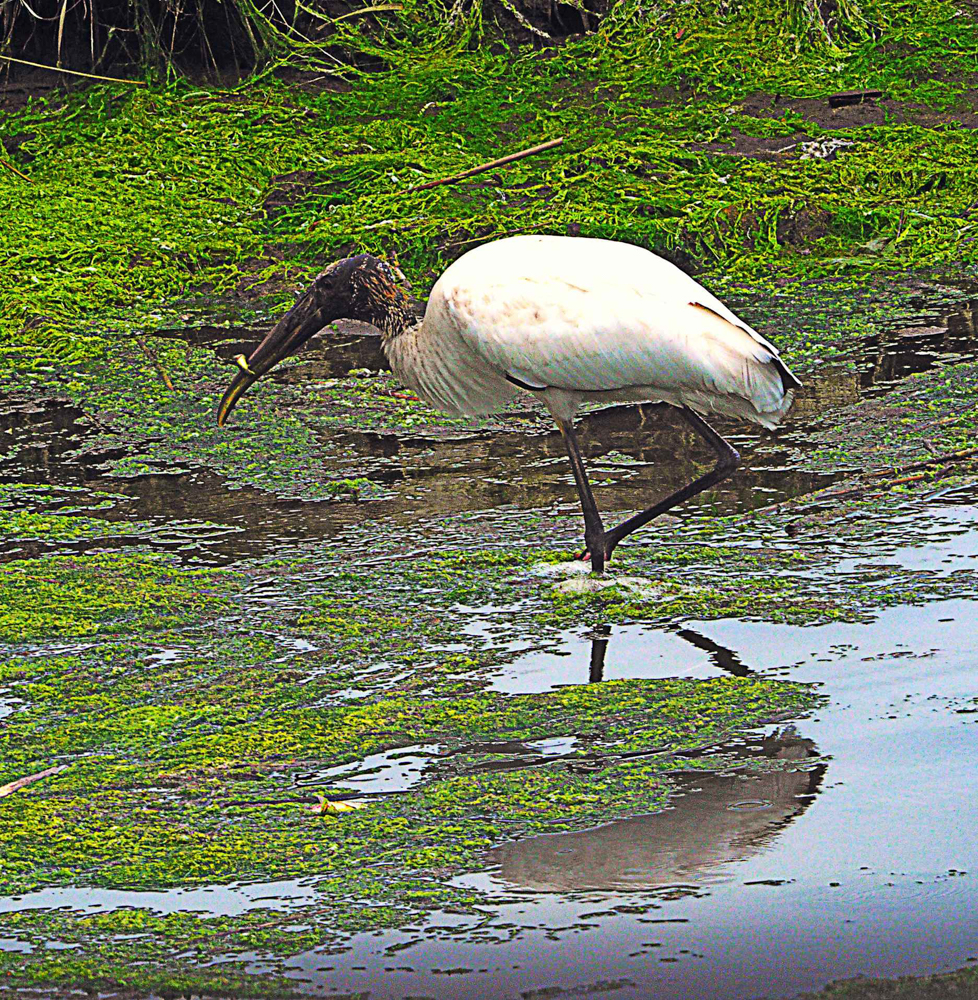
2021-11-A/B One, Westhampton, Suffolk, 2, 3, 6-8 May (Eileen Schwinn, Susan Saunders, ph E. Schwinn, S. Saunders). eBird 6-15 May
2021-19-A One, Matrix Global Logistics Park, Richmond, 1 Aug (David Gillen, ph D. Gillen). eBird 31 Jul, 1, 2, 5-9 Aug
2021-27-A One, Knox-Marsellus Marsh, Montezuma NWR, Seneca, 21 Jul (Dennis Anderson). eBird 20-31 Jul, 1, 4-17 Aug
Wood Stork has a long history of occasional records in New York, with the reason for such occurrences often suggested as being caused by drought in their core range in the southeastern states. Five records in one year, however, including two eBird records listed under the 2021 eBird Records Automatically Accepted by NYSARC, is extremely unusual and may suggest that this species is expanding northward like so many other waterbirds. Most of the birds that show up in the state are juveniles, and the birds at Montezuma NWR and Staten Island conformed to that, as did the two eBird records listed further on in this report. However, the Long Island bird appears to be an older immature, as it showed an all-dark bill. This individual was found by Susan Saunders, who was photographing birds when she spotted it. After making a post to Facebook, she learned that it was a Wood Stork and she then notified the Eastern Long Island Audubon Society, who in turn eventually got the word out to birders. The Staten Island bird was discovered by Anthony Ciancimino while the stork at Montezuma NWR was found by Les Preston. There were two eBird records that were also accepted, from Columbia and Orleans Counties. See the “2021 eBird Records Automatically Accepted by NYSARC”, further on in this report.
 Roseate Spoonbill
photo
© Kevin McGann
Roseate Spoonbill
photo
© Kevin McGann
(click photo to enlarge)
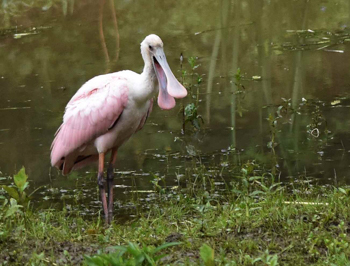
Roseate Spoonbill (Platalea ajaja)
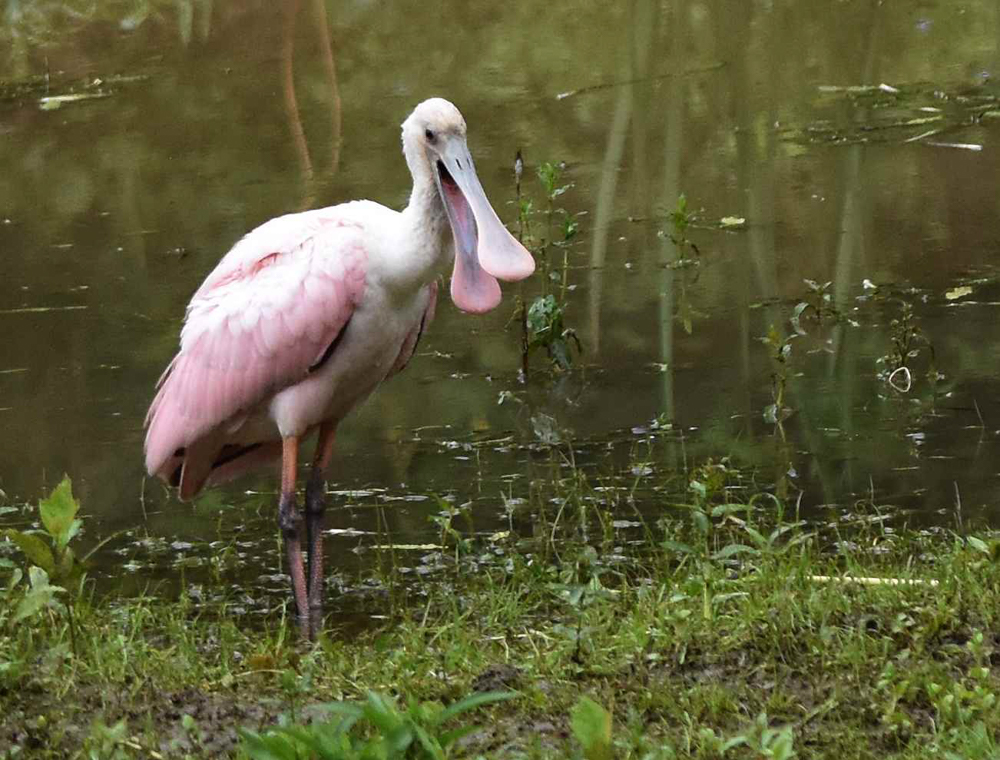
2021-13-A One, Hamden, Delaware, 7 Jul (Landa Palmer, ph L. Palmer). eBird 7 Jul 2021-14-A/B One, Montezuma NWR, Seneca, 11 Jul (Kevin McGann, Dennis Anderson, ph K. McGann). eBird 11-14, 17-30 Jul, 1-18, 20-22, 27-30 Aug, 1, 3, 4, 6, 7, 9-15, 17 Sep
2021-15-A One, Chenango Valley State Park, Broome, 11 Jul (Kevin McGann, ph K. McGann). eBird 11 Jul
2021-16-A One, Wallkill River NWR, Orange, 14 Jul (Linda Scrima, ph L. Scrima). eBird 14 Jul
2021-20-A One, Poughkeepsie, Dutchess, 22-24, 26-28 Jul (Debbie van Zyl, ph D. van Zyl). eBird 21-28 Jul
2021-24-A One, Cold Spring Harbor, Suffolk/Nassau, 25 Jul (Pat Palladino, ph P. Palladino). eBird 22, 25-31 Jul, 2-7 Aug
With only two records of Roseate Spoonbill in the state prior to 2021—in 1992 and 2018—birders were stunned to see what occurred in 2021. In recent years there have been more records further north than traditionally seen, such that one or two in New York might not have been that unexpected, but ten?! It all started on 7 Jul when a Delaware County resident noticed a large bird in his pond and called Landa Palmer to come over and help with the identification. Palmer was able to obtain excellent photos of an immature Roseate Spoonbill. His formal submission and eBird checklist are the only reports for this individual. Two more spoonbills showed up only four days later, one a long-staying bird at Montezuma NWR and the other a one-day wonder in Broome County, the latter found by Susan Thorne. On 14 Jul at Wallkill River NWR, Linda Scrima had the good fortune to have a spoonbill fly past her while she had her camera in hand, enabling her to capture some diagnostic images. It was the homeowner who first noticed and identified a spoonbill on his property in Poughkeepsie. He contacted Barbara Michelin and word soon spread through the birding community, allowing many to see this lovely bird over the course of a week. The Cold Spring Harbor bird was found by Russell Taylor and LF Melliny at Laurel Hollow and was seen in both Nassau and Suffolk Counties, providing a first record for both over the course of two weeks. Another Nassau County record at East Meadow Island involved a bird that showed up mere hours after the Laurel Harbor bird, and a third for the county was found at Beaver Lake in September. Tompkins County had its first record in August while Washington County recorded its first on 24 Jul. See the “Other 2021 eBird Records Accepted by NYSARC” further on in this report. All of the 2021 New York spoonbill records with photos were juveniles.
Swallow-tailed Kite (Elanoides forficatus)
2021-18-A One, Woodbury, Nassau, 25 Jul (Michael Zito)
This species has become fairly regular in the state with NYSARC accepting records in nine of eleven years (2012 through 2022), plus additional records in 2023 and 2024, pending review and acceptance. Michael Zito and Robert Taylor were driving by the Oyster Bay Golf Course when they noticed a raptor with an unexpected shape of narrow pointed wings and a deeply forked tail. Although a bit uncertain of the identification at first due to distance, they were able to drive closer and get good views of this distinctive species, noting the black back, wings, and tail with a white head and underparts. They tried to get a photo but the bird dropped below the tree line and evaded further attempts. In addition to this record from Nassau County, the Committee accepted five others in 2021, from Cortland, Monroe, Onondaga, Suffolk, and Yates Counties. See the “2021 eBird Records Automatically Accepted by NYSARC” and the “Other 2021 eBird Records Accepted by NYSARC”, further on in this report.
Swainson’s Hawk (Buteo swainsoni)
2021-28-A One, Chestnut Ridge Hawkwatch, Westchester, 4 Sep (Richard Aracil). eBird 4 Sep
While alone at the Chestnut Ridge Hawkwatch, Richard Aracil had the good fortune of having a molting Swainson’s Hawk fly over. The photos in his eBird checklist are diagnostic of the species. Three other eBird records of this species were accepted by the Committee in 2021, two in Monroe County and one in Richmond County. See the “Other 2021 eBird Records Accepted by NYSARC”, further on in this report.
 Ferruginous Hawk
photo
© Linda Scrima
Ferruginous Hawk
photo
© Linda Scrima
(click photo to enlarge)
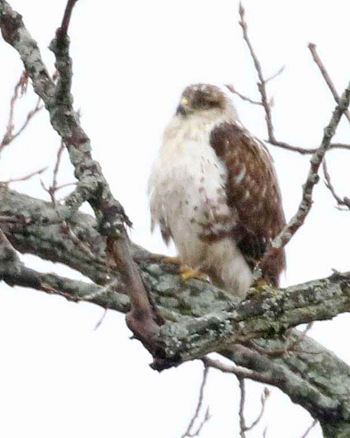
Ferruginous Hawk (Buteo regalis)
2021-3-A/C One, Towns of Wawayanda and Warwick, Orange, 16-17 Jan (John H. Haas, Carena Pooth, Linda Scrima, ph J. Haas, L. Scrima). eBird 16-23, 25, 27, 28, 30, 31 Jan,
3-8, 10, 12-14, 17, 19-21, 24-26 Feb, 2, 4, 6, 7, 10, 13 Mar
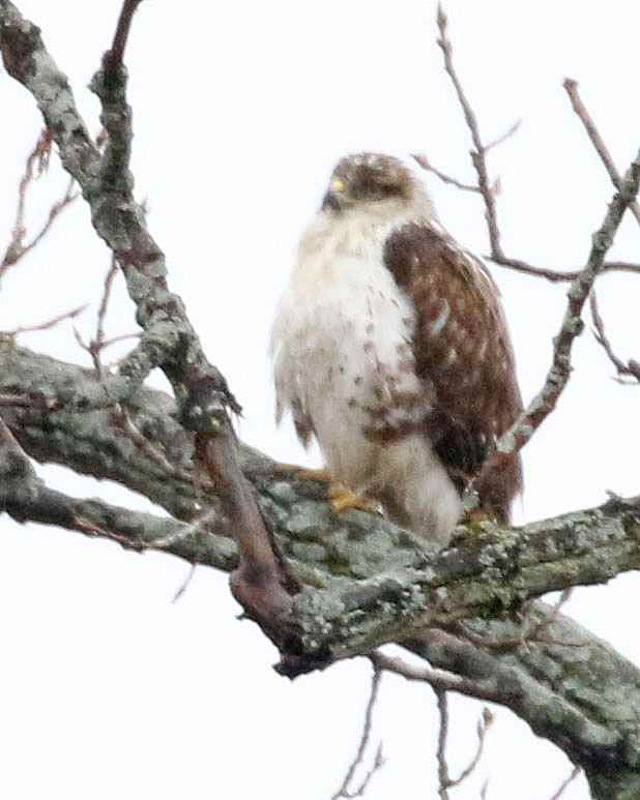
This thrilling first state record, found by Linda Scrima, lingered in the area for two months, delighting hundreds of birders. For a full account of this record, see Healy (2024).
Ash-throated Flycatcher (Myiarchus cinerascens)
2021-35-A/B One, Jones Beach State Park, Nassau, 3, 5 Nov (Jennifer Wilson-Pines, David Gillen, ph J. Wilson-Pines, D. Gillen). eBird 3, 5 Nov
2021-41-A One, Rockefeller State Park, Westchester, 25 Dec (John H. Haas, ph J. Haas). eBird 18, 24-31 Dec 2021, 1 Jan 2022
The Ash-throated Flycatcher in Rockefeller SP was discovered by Richard Leonard on 18 Dec but it was not seen by other birders until Steve Rappaport relocated it on Christmas Eve. As stated in the 2020 annual report (D’Anna, et al. 2024), this species is far and away most likely to occur in the downstate region. With the record from Rockefeller SP, Westchester is now the first county north of New York City with more than one record. The only other record from that county was on 21 Nov 1970 and it provided the first for the state! The flycatcher at Jones Beach was reportedly found by Barbara Garriel. There was one other record in 2021, a bird found in perhaps the most typical area of the state for this species— Kings County. See the “Other 2021 eBird Records Accepted by NYSARC”, further on in this report.
Gray Kingbird (Tyrannus dominicensis)
2021-32-A/C One, Fire Island Lighthouse, Robert Moses SP, Suffolk, 13 Oct (Eileen Schwinn, Byron Young, Terry McCauley, ph E. Schwinn). eBird 13 Oct
It was during an Eastern Long Island Audubon Society field trip, led by Eileen Schwinn, when this bird was discovered. It was in view for less than ten minutes and apparently was not seen again. Three members of the field trip submitted documentation to NYSARC. This was one of two Gray Kingbirds in the state in 2021, with the other being an individual that lingered for ten days on Staten Island. See the “Other 2021 eBird Records Accepted by NYSARC”, further on in this report.
Say’s Phoebe (Sayornis saya)
2021-31-A One, Cupsogue County Park, Suffolk, 11 Sep (Eileen Schwinn, ph E. Schwinn). eBird 11 Sep
2021-33-A/B One, Caumsett State Historic Park, Suffolk, 16, 18, 22 Oct (David Gillen, Jennifer Wilson-Pines, ph D. Gillen, J. Wilson-Pines). eBird 14-25, 28-31 Oct, 1-9 Nov Although not seen every year in the state, Say’s Phoebe is clearly increasing, with 2021 accumulating two more records. Long Island has more records than any other part of New York and the two birds found this year fit into that pattern. The bird at Cupsogue was discovered by Lucas Musher, Ben Bolduc, and Jay Rand but was only seen during the morning of the day it was found. The bird found by Ken and Sue Fuestel at Caumsett County Park was much more cooperative, staying for nearly four weeks.
Loggerhead Shrike (Lanius ludovicianus)
2021-23-A One, Sammy’s Beach, Northwest Harbor, Suffolk, 10 Jul (Pat Palladino)
The Loggerhead Shrike at Sammy’s Beach was found by Anthony Collerton and provided only the second record for Long Island reviewed and accepted by NYSARC since 2002. An eBird report with photos of another bird from Asharoken, Suffolk County in May of 2021 will be reviewed by NYSARC in an upcoming meeting.
 Violet-green Swallow
photo
© John Hershey
Violet-green Swallow
photo
© John Hershey
(click photo to enlarge)
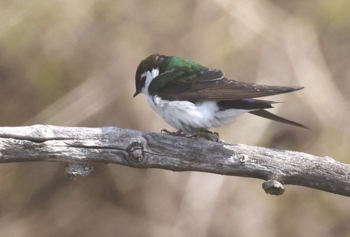
Violet-green Swallow (Tachycineta thalassina)
2021-22-A One, Vischer Ferry Nature & Historic Park, Saratoga, 22 Apr (John Hershey, ph J. Hershey). eBird 22 Apr
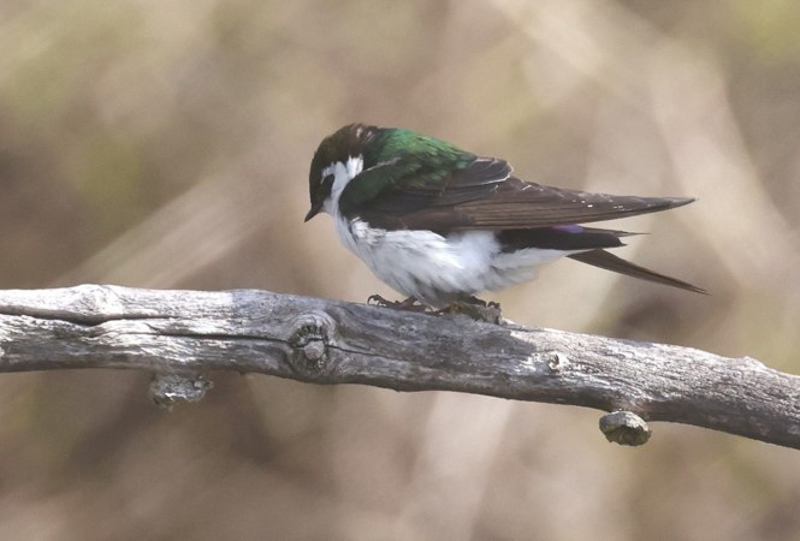
John Hershey was photographing birds at Vischer Ferry and did not realize what he had captured until he reviewed his photos on a large screen later the same day. Mixed in with the Rough-winged Swallows that were perched on the small branches of a tree was this amazing Violet-green Swallow, which provided the first record for New York. The ethical and rhetorical question is, since he did not actually note the bird in the field, can he count it? Certainly, that is a personal decision and one which most birders would be hard-pressed to resist. For a full account of this record, see Healy (2024).
 Gray-breasted Martin
photo
© Doug Gochfeld
Gray-breasted Martin
photo
© Doug Gochfeld
(click photo to enlarge)
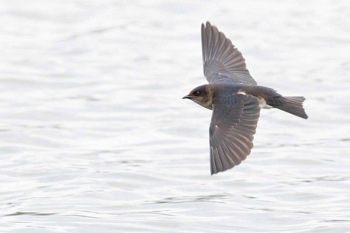
Gray-breasted Martin (Progne chalybea)
2021-10-A/D One, Prospect Park, Kings, 1-3 Apr (John Gaglione, Tim Healy, Doug Gochfeld, Shaibal S. Mitra, ph J. Gaglione, T. Healy, D. Gochfeld; audio D. Gochfeld). eBird 1-4 Apr
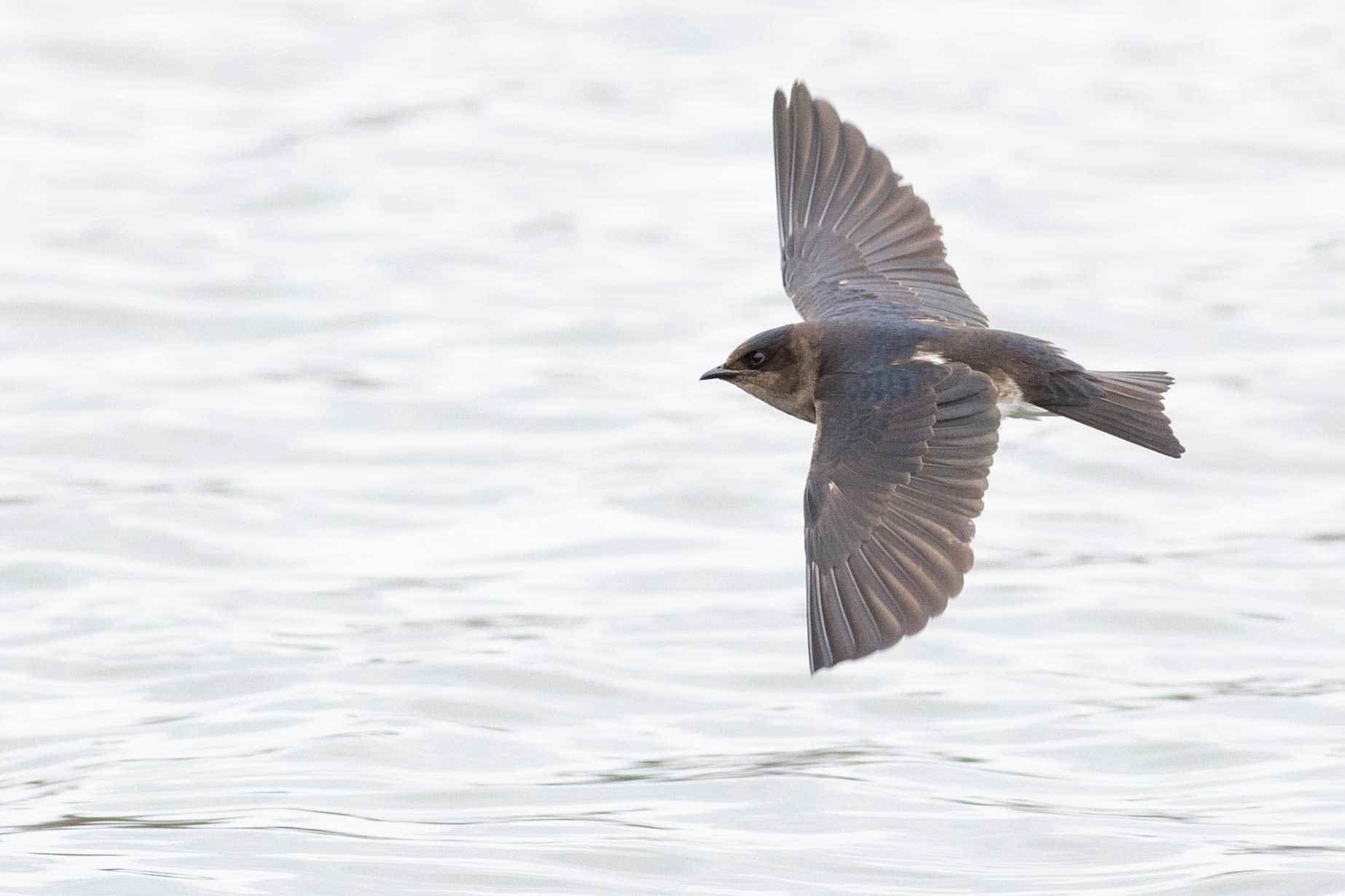
Extraordinary, astounding, incredible—choose your adjective. This is simply one of the most unexpected first state records in recent times. We could only find two old records of Gray-breasted Martin north of Mexico. Both were specimens taken in Texas, one on 25 Apr 1880 and the other on 18 May 1889 (Texas Bird Records Committee 2024). Not only is it unlikely for this Central and South American swallow to reach New York but it is an extremely challenging identification, making the odds of one actually being identified here that much smaller. But with a great deal of luck and the sharp eyes, knowledge, and photographic/audio recording skills of ace birder and finder, Doug Gochfeld, New York now has a well documented record of this species. For all of the exciting details, be sure to check out Healy (2024).
Varied Thrush (Ixoreus naevius)
2021-30-A/D One, Sands Point Preserve, Port Washington, Nassau, 5 Oct (Jennifer Wilson-Pines, Justin Frankl, Michele Ventresca, Barbara Garriel, ph J. Wilson-Pines). eBird 5 Oct
This bird had a group of birders puzzled until they looked at the photos on Jennifer Wilson-Pines camera. Bill Belford then recognized it immediately as a Varied Thrush. It was darker than it typically appears in New York and may have been retaining some juvenile plumage. However, the orange supercilium, throat, and wing markings were still visible, which along with the thrush-like shape and robin size, enabled identification. The 5 Oct date is much earlier than usual and in fact it is the earliest fall date for any record accepted by NYSARC (NYSARC Online Database). There is one earlier report in eBird from Albany County, on 1 Sep 1978, which has not been reviewed by NYSARC. One other Varied Thrush was found in the state in 2021, a bird at a feeding station in Suffolk County. See the “Other 2021 eBird Records Accepted by NYSARC”, further on in this report.
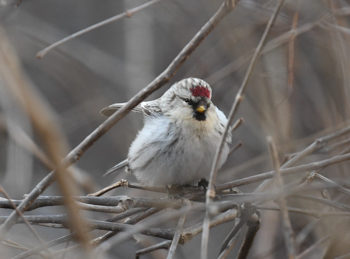 Hoary Redpoll
photo
© Larry Trachtenberg
Hoary Redpoll
photo
© Larry Trachtenberg
(click photo to enlarge)
Hoary Redpoll (Acanthis hornemanni)
2021-7-A One, Croton Point Park, Westchester, 21 Jan (Larry Trachtenberg, ph Karalyn Lamb). eBird 21, 28, 30, 31 Jan, 4, 5, 14, 17 Feb
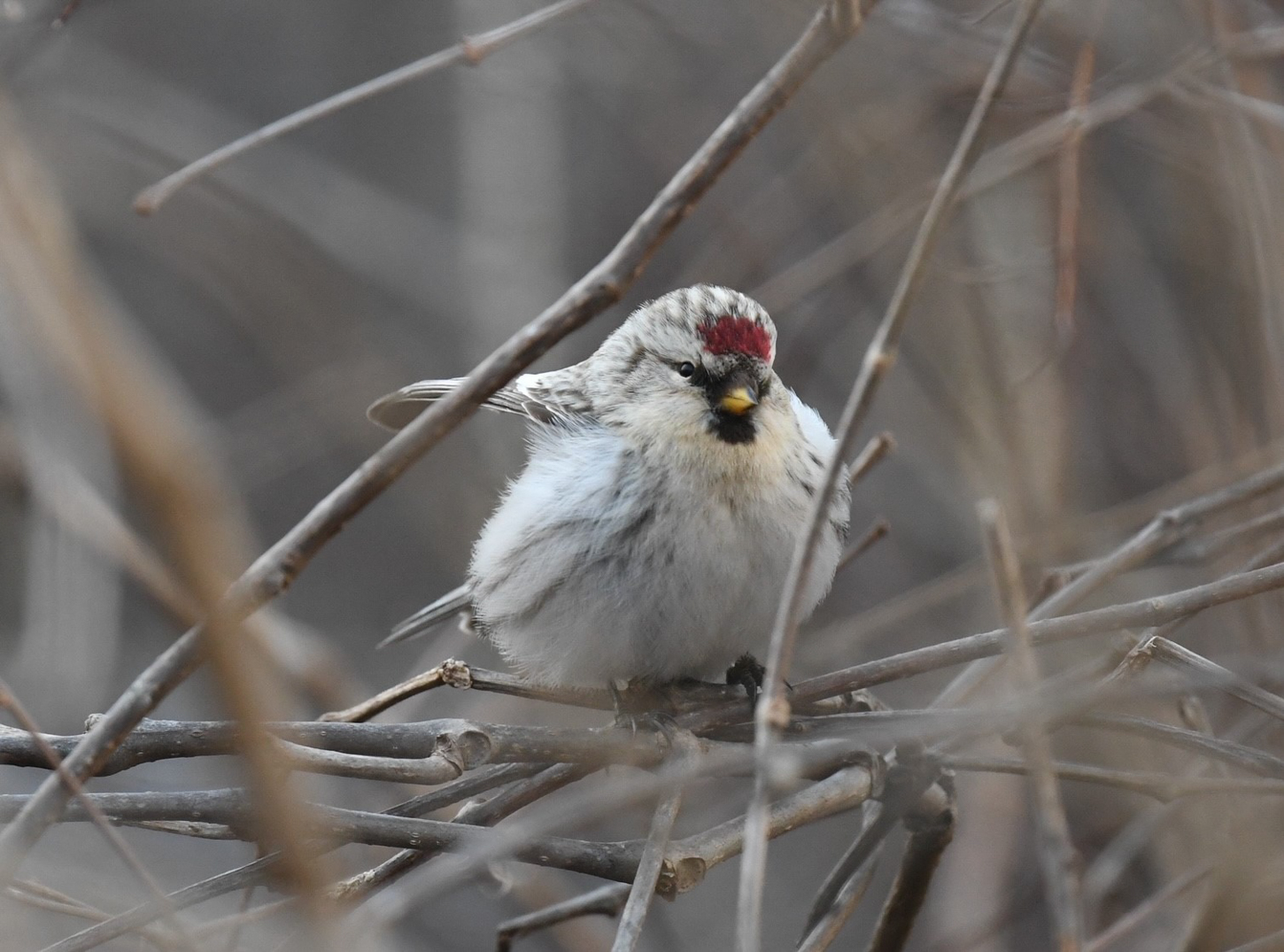
Redpolls as far south as Westchester County are unusual but in this irruption year, there was a flock of Common Redpolls hanging around in Croton Point Park. On 21 Jan, Larry Trachtenberg found a very pale individual in the flock that he suspected could be this species. He sent photos taken by Karalyn Lamb to other birders, who confirmed the identification. There has only been a single record in the state further south than this one that has been reviewed and accepted by NYSARC, a bird in Suffolk County in 1981. In 2024, the American Ornithological Society lumped Common Redpoll, Hoary Redpoll, and the Lesser Redpoll of Europe, which are now called, simply, Redpoll (Acanthis flammea).
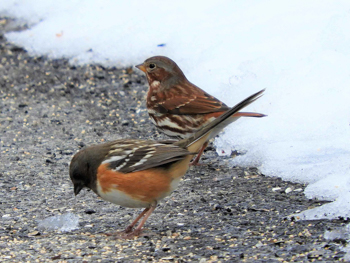 Spotted Towhee
photo
© John Gaglione
Spotted Towhee
photo
© John Gaglione
(click photo to enlarge)
Spotted Towhee (Pipilo maculatus)
2021-1-A/B One, Baldwin Park, Nassau, 4 Jan, 22 Feb (Michael Zito, John Gaglione, ph M. Zito, J. Gaglione). eBird 2-9, 11, 12, 14-16 Jan, 12-17, 20-24, 26 Feb
Veteran Long Island birders Shai Mitra and Pat Lindsay were checking a favorite thicket on the Southern Nassau County CBC when they spotted this bird. Recognition was quick and Mitra soon began taking photos. Spotted Towhee is exceptionally rare in New York with this being only the second record that has been reviewed and accepted by NYSARC, though there is a specimen and some other older records that NYSARC has not reviewed and which are considered correct by some authorities (Buckley 1998). The Baldwin Park towhee was a female and was seen by many over an eight-week span, though there was a four- week gap in sightings between mid January and mid February.
Western Tanager (Piranga ludoviciana)
2021-29-A/B One, Coney Island, Kings, 26 Sep (Michael Yuan, Ryan Mandelbaum, ph M. Yuan, R. Mandelbaum). eBird 26 Sep
2021-36-A/B One, Carl Schurz Park, New York, 24 Nov, 6 Dec (Joseph Zemann, Adrian Burke, ph J. Zemann). eBird 25-30 Nov, 1-7, 9-13, 15-17, 19-29, 31 Dec 2021, 1-9, 12-18,
21-24, 26-28, 31 Jan, 1, 2, 4-7, 9, 11, 12, 16, 17, 19-22, 24-26 Feb, 1-5, 10, 12, 15, 17, 19-
21, 23, 25, 27-29 Mar 2022
2021-38-A One, Central Park, New York, 16 Dec (Sandra Beltrao, ph S. Beltrao). eBird 16 Dec
2021-39-A One, Clinton Community Garden, New York, 13, 14, 18 Dec (Adrian Burke, ph A. Burke). eBird 13, 14, 18-20 Dec 2021, 5-7, 9,10, 12, 19, 22 Jan 2022
2021 saw the addition of four more records of Western Tanager, with all four occurring in New York City. The female at Carl Schurz Park may well have been the long-staying bird returning from the previous winter. In 2020 it was first discovered on 16 Dec and stayed until 18 Apr 2021, while the 2021 tanager was first reported on 24 Nov by Joseph Zemann and last reported on 29 Mar 2022. Michael Yuan and Ryan Mandelbaum found a female-type Western Tanager on Coney Island that was not seen in the following days. Kristopher John found one in Central Park, which also was not seen on subsequent days. The female-type tanager at the Clinton Community Garden was found by Adrian Burke and lingered for over a month.
Painted Bunting (Passerina ciris)
2021-8-A One, Pearl River, Rockland, 20 Feb (Dawn Hannay, ph D. Hannay). eBird 20, 21 Feb, 21 Mar
Dawn Hannay’s friend, a non-birder, contacted her about a striking bird that showed up at her feeding station on 18 and 19 Feb. She gave Hannay a description after the first day and sent an image from her cell phone after the second. The
friend’s description and photo indicated that it was a Painted Bunting. Hannay wanted to confirm the identification, as well as document the sighting, so she went to her friend’s home the following day. The bird soon appeared at the feeders, a beautiful adult male. Two other records of Painted Bunting were also found in 2021, an adult male in Monroe County and another adult male in Chenango County. See the “2021 eBird Records Automatically Accepted by NYSARC”, further on in this report.
2021 Formal Submissions Not Accepted
Steller’s Sea-Eagle (Haliaeetus pelagicus)
2021-40-A One, Cobleskill, Schoharie, Jan or Feb
This bird was observed by a non-birder on his morning walk. The bird was perched in a tree at first and took flight when he approached. Sometime after the observation, he saw an article about the Steller’s Sea-Eagle in Massachusetts. Since the bird appeared much larger than the Bald Eagles that he sees in the area and it lacked a white head, he felt that it matched the description of the bird in the article. It is not clear from the report if the observer was familiar with immature plumages of Bald Eagle, which of course also do not have a white head. Birders in New York have been hoping the long-staying Steller’s Sea-Eagle that has graced coastal areas of Maine, Massachusetts, and the Canadian maritime provinces would one day find its way to our state. Should that occur, photos will almost certainly be necessary for this species to be accepted, given its similarity to Bald Eagle (H. leucocephalus), as well as to White-tailed Eagle (H. albicilla).
Zone-tailed Hawk (Buteo albonotatus)
2021-42-A One, I-84 Overlook Hawkwatch, Orange, 7 Sep
This was an intriguing report from an experienced hawk-watcher, about a bird that he saw in binoculars over the next ridge, roughly a mile away. The description provided was relatively brief. He thought it was a Turkey Vulture at first, with a dark head, wings held in a “V”, rocking, and legs hanging down. When it turned, he saw that the tail was banded black and white exactly like an adult Broad- winged Hawk with a wider terminal black band. The bird suddenly dropped a wing and spiraled down about 15 feet before leveling off. The observer claimed that he knew immediately that it was a Zone-tailed Hawk. Taken at face value, this does sound like a Zone-tailed Hawk. However, Committee members were skeptical that these features could be determined accurately at such a distance using only binoculars. And in any case, reports of such a mega-rarity would be difficult to accept without stronger documentation. Even though the Committee did not accept the record, they still appreciate submissions such as this.
Great Gray Owl (Strix nebulosa)
2021-37-A One, DeKalb Junction, St. Lawrence, 2 Dec
This observation was made by someone who was in thick woods looking for a Christmas tree. The bird flew over the observer and landed on a branch above him. He noted the “round gray face and white chin(?) patch”. The question mark suggested to some reviewers that he was uncertain of exactly where the white was. It was large and he thought it was an eagle at first. After a minute, it silently flew off. He noted that he hears owls there every night and that the bird had no horns or white on the face. With no mention of other species by name, Committee members could not tell how familiar he was with the expected species in the area. And with few details and no photos, the Committee decided that the record was not supported.
Bewick’s Wren (Thryomanes bewickii)
2021-2-A One, Cameron Mills, Steuben, 3 Jan
An observer saw this bird in his yard. Apparently, he was aware that they get Carolina Wrens in their yard also. What set this bird apart to him was that he thought it appeared slightly darker, plus its tail markings, though he did not indicate what about the tail markings were different. Three photos were submitted with this report and in two of them, the bird does look slightly darker on the upperparts than a Carolina Wren. However, the bird does not show the white tail corners that Bewick’s Wren is known for, making it evident that the bird was actually a Carolina Wren and that the photos were underexposed. The third photo is exposed properly and shows a typical Carolina Wren.
Townsend’s Solitaire (Myadestes townsendi)
2021-5-A One, Yonkers, Westchester, 31 Jan
This report came from an admitted amateur birder who had this bird in his yard while he saw it from inside his home with the unaided eye. He estimated that it was only six feet away. The bird was described as about the size of a robin, grayish tan, with lighter and browner scallop markings on the folded wingtips. He thought it might have an eyering, which is a key field mark, but he was uncertain. He noted that it was the wrong color for a Gray Catbird or a Northern Mockingbird but did not explain how it differed—all three species have considerable gray in the plumage. With no photos and few key details, the Committee could not accept the record.
1979 Formal Submission Re-review
Baird’s Sandpiper (Calidris bairdii)
1979-28-A/C Three, NY Rt 22, northeast of Amenia, Dutchess, 31 May
This record was requested to be re-reviewed after one Committee member looked at the digital scans of the original photos and was unable to make out any Baird’s Sandpipers. These same scans were sent out to the rest of the Committee and the necessary three votes to reopen the record were obtained. Following this, the Secretary located the original file for this record and discovered several slides that were not part of the digital images. He projected the slides onto his basement wall and found one that looked promising. He then took a cell-phone image of the slide and forwarded it to the Committee members. The members agreed that the bird in the photo was a Baird’s Sandpiper. Although there was some concern that the bird on the slide may have been the only Baird’s Sandpiper present, most of the Committee was hesitant to question the original count of three. In the end the vote was unanimous to accept the record. It should be noted that records of Baird’s
Sandpiper in spring are extremely rare, with this being only one of three that have been reviewed and accepted by NYSARC.
Formal Submission Contributors:
Dennis Anderson, Ajit I. Antony, Richard Aracil, Sandra Beltrao, Adrian Burke, Gary Chapin, Sarah Forestiere, Justin Frankl, Marianne Friers, John Gaglione, Barbara Garriel, David Gillen, Doug Gochfeld, Eamon Goodwin, Richard Guthrie, John H. Haas, Dawn Hannay, David W. Harrison, Tim Healy, John Hershey, Michael Higgiston, Darcy Krasne, Karalyn Lamb, Anthony Macchiarola, Joshua Malbin, Ryan Mandelbaum, Terry McCauley, Kevin McGann, Shaibal S. Mitra, Duane Otto, Rita Otto, Pat Palladino, Landa V. Palmer, Peter Paul, Carena Pooth, Gregg Recer, Susan Saunders, Eileen Schwinn, Linda Scrima, Noel Sylvester, Barb Thomascall, Larry Trachtenberg, Adam Troyer, Debbie van Zyl, Michele Ventresca, Carl Ventrice, Jennifer Wilson-Pines, Byron Young, Michael Yuan, Joseph Zemann, Michael Zito.
2021 eBird Records
The Committee began to review accepted eBird records for the first time in 2020. The 2019 eBird records were reviewed concurrently with the 2019 formal submissions in 2020 and published together in the 2019 annual report (see D’Anna, et al. 2023), marking the first time that the Committee has published eBird records that we reviewed and accepted. Due to the much greater number of reviews that are necessary with the addition of eBird records, we have developed some time-saving procedures. The “auto-accept list” is a list of species reported to eBird which we will automatically accept, if the record includes an unambiguous photo, usually determined by the secretary, Gary Chapin. The species on this list are usually ones that are straightforward to identify in a photo and are not extreme vagrants. Records accepted in this manner are listed in this report under “2021 eBird Records Automatically Accepted by NYSARC”. For the remaining eBird records, we have developed a procedure whereby each member only reviews three-sevenths of the records. Every eBird record is reviewed by three Committee members. If all three members vote to accept, the record is thereby accepted. Although this may seem like a lower standard than we use for reviewing formal submissions, it should be remembered that the record has already been reviewed and accepted by an eBird reviewer. In addition, if just one member or more votes not to accept, the record is then adjudicated by the entire Committee, using the same voting procedures as for formal submissions. And finally, any decisions on eBird records can be challenged and reviewed by the entire Committee at any time, should a member request it. Records accepted in this manner are listed in this report under “Other 2021 eBird Records Accepted by NYSARC”.
This is the third annual report that includes decisions on eBird records. Only eBird records which we decided to accept are included. For eBird records for which we also reviewed a formal submission, the record is only listed with the formal submissions. Unlike with a formal submission, where an observer voluntarily submits a report to NYSARC, observers of an eBird record have not
requested that NYSARC review their report. Therefore, to avoid possible embarrassment, eBird records which we did not accept are not shown. Also, to save time and space, the observers’ names for the accepted eBird records have been left out.
As with formal submissions, eBird records are given a unique NYSARC number. The number refers to all the accepted eBird reports at all of the locations and dates where and when that individual bird or birds occurred. An “e” at the end of the number distinguishes eBird records from formal submission records. Unlike formal submission reports, which may have eBird reports that also support the same record, there are no formal submissions supporting these eBird records.
The committee would like to know about any errors and omissions found by the reader. This will enable us to keep a more accurate and complete database. Sightings can be added to eBird or removed from eBird at any time after the sighting, even years afterward. The records listed here were captured at one moment in time and may differ from the current eBird record shown online. There could be discrepancies between the dates of accepted records listed and those that currently appear in eBird. If a record does not appear here but shows in eBird, it could be because it was accepted by an eBird reviewer but not accepted by NYSARC. It is also possible that the record was added to eBird after records from that year were reviewed by the Committee. Also, if you notice a record listed here that does not show in eBird, it could be because the checklist was deleted by the observer or hidden from public view. For any of these, we would greatly appreciate hearing about them—please email the NYSARC secretary, Gary Chapin, at: nysarc44@nybirds.org.
2021 eBird Records Automatically Accepted by NYSARC
Note: These are eBird records that were accepted on the basis of an unambiguous photograph.
2021-44e Black-bellied Whistling-Duck, Seven, Cayuga Lake SP, Seneca, 11 Jun
2021-45e Black-bellied Whistling-Duck, One - two, Montezuma NWR, Seneca, 29-31 Jul, 1-3, 5-8 Aug
2021-46e Black-bellied Whistling-Duck, Four, Mattituck, Suffolk, 15, 16 Jul
2021-47e Black-bellied Whistling-Duck, One, Bayard Cutting Arboretum SP, Suffolk, 31 Oct
2021-49e Pink-footed Goose, One, Wappinger Lake, Dutchess, 26, 27 Nov
2021-50e Pink-footed Goose, One, Northport Golf Course, Suffolk, 24, 25 Jan
2021-51e Pink-footed Goose, One, Norwood Rd, Northport, Suffolk, 1 Mar
2021-52e Pink-footed Goose, One, Bridgehampton, Suffolk, 28, 29 Nov, 6 Dec
2021-53e Pink-footed Goose, One, Wrights Loop, Saratoga and Easton, Washington, 15 Mar
2021-54e Barnacle Goose, One, Westville and Trout River, Franklin, 6-8 Nov
2021-55e Barnacle Goose, One, Montezuma NWR, Seneca, 19, 20 Nov
2021-60e Eurasian Collared-Dove, One, Ellicott Rd, Portland, Chautauqua, 15-22 Mar
2021-61e Eurasian Collared-Dove, One, Breezy Point Tip, Queens, 28 Jul
2021-62e White-winged Dove, One, Salt Marsh Nature Center at Marine Park, Kings, 20 Sep
2021-63e White-winged Dove, One, Braddock Bay Park – Hawk Watch, Monroe, 8 May
2021-64e White-winged Dove, One, Landing Estates, Hampton Bays, Suffolk, 30 Jun, 1, 3, 5, 6 Jul
2021-68e Purple Gallinule, One, Jamaica Bay Wildlife Refuge, Queens, 1-3 Jul
2021-71e Black-necked Stilt, One, Iroquois NWR – Kumpf Marsh, Genesee, 30-31 May, 1-2 Jun
2021-74e Ruff, One, Iroquois NWR – Kanyoo Trail, Genesee, 11, 12 May
2021-75e Ruff, One, Montezuma NWR, Seneca, 22 May
2021-76e Ruff, One, Moriches Island, East Moriches, Suffolk, 17 May
2021-86e Thick-billed Murre, One, Coney Island Beach, Kings, 6 Feb
2021-88e Thick-billed Murre, One, Page Ave. Beach, Richmond, 7 Feb
2021-89e Thick-billed Murre, One, Foster Memorial Town Beach, Suffolk, 12, 20 Feb
2021-101e Bridled Tern, One, Pelagic (39.74062, -71.62334), Suffolk, 7 Aug
2021-102e Bridled Tern, Three, Pelagic, (39.54275, -72.38161; 39.53739, -72.37628; 39.54375, -72.40708), Suffolk, 27 Aug
2021-108e White-faced Storm-Petrel, Pelagic (39.30564 -70.91211), Suffolk, 17 Aug
2021-111e White-faced Storm-Petrel, Pelagic (39.997194, -72.697000), Suffolk, 16 Oct
2021-116e Wood Stork, German Church Rd, Ghent, Columbia, 4-7 Aug
2021-117e Wood Stork, Bald Eagle Creek Marina, Orleans, 11 Oct
2021-133e Tricolored Heron, Ausable Marsh WMA, Clinton, 30 Jun, 1 Jul
2021-134e White Ibis, Camel Farm, Westtown, Orange, 18 Oct
2021-135e White-faced Ibis, Braddock Bay – East Spit, Monroe, 22-23 May
2021-136e White-faced Ibis, Braddock Bay – East Spit, Monroe, 29 Jun
2021-137e White-faced Ibis, Jamaica Bay Wildlife Refuge, Queens, 13, 15-23 Jun, 4, 5, 9, 11, 13, 14, 19, 21 Jul
2021-138e White-faced Ibis, Montezuma NWR and Northern Montezuma NWR, Seneca, Wayne, Cayuga, 15, 18 May
2021-139e White-faced Ibis, Captree Island, Suffolk, 30 Apr, 1, 3 May
2021-144e Swallow-tailed Kite, Marathon, Cortland, 12 Sep
2021-146e Swallow-tailed Kite, Otisco Lake Park, Onondaga, 21 Aug
2021-147e Swallow-tailed Kite, Shelter Island Heights, Suffolk, 6 Jun
2021-148e Swallow-tailed Kite, Yatesville, Yates, 23-31 Aug, 1, 3-12, 14 Sep
2021-152e Mississippi Kite, Braddock Bay Park and Edgemere Dr, Monroe, 25 May
2021-153e Mississippi Kite, Braddock Bay Park – Hawk Watch, Monroe, 26 May
2021-162e Western Kingbird, Lisle, Broome, 21 Oct
2021-164e Scissor-tailed Flycatcher, Dunkirk Airport, Chautauqua, 19-22 Oct
2021-170e Northern Wheatear, Sandy Pond Outlet, Oswego, 6, 7 Oct
2021-171e Northern Wheatear, Miller Field, Richmond, 29 Sep
2021-187e Lark Sparrow, Kingston Reservoir #1, Ulster, 20 Aug 2021-197e Harris’s Sparrow, Point Gratiot, Chautauqua, 19 May
2021-204e Black-throated Gray Warbler, Amherst SP, Erie, 20-24 Apr
2021-205e Black-throated Gray Warbler, Preston Ponds Complex, Manorville, Suffolk, 14 May
2021-206e Townsend’s Warbler, Tifft Nature Preserve, Erie, 13 Sep
2021-207e Townsend’s Warbler, Green-Wood Cemetery, Kings, 9, 10 Sep
2021-208e Painted Bunting, Bainbridge, Chenango, 15 May
2021-209e Painted Bunting, Greece, Monroe, 11-14 Dec
Other 2021 eBird Records Accepted by NYSARC
Note: These are records, other than automatically accepted records, that were accepted after being reviewed according to the procedures outlined above under “2021 eBird Records”.
2021-48e Greater White-fronted Goose (Greenland), One, Wrights Loop, Saratoga, 17 Mar
2021-65e King Rail, One, Orchard Park, Erie, 3 May. This record involves a bird that was recorded migrating overhead at night.
2021-66e King Rail, One, Tillman Rd WMA, Erie, 10, 11 Jun
2021-67e King Rail, One, Iroquois NWR-Kumpf Marsh, Genesee, 31 May, 1-6, 8, 16-18, 22 Jun, 3 Jul
2021-70e Sandhill Crane (canadensis), One, Montezuma NWR, Seneca, and Armitage Rd, Wayne, 10, 17 Dec
2021-72e Northern Lapwing, One, Santapogue Creek and Bergen Point Golf Course, Babylon, Suffolk, 18 Dec
2021-73e Common Ringed Plover, One, Sandy Pond Outlet, Oswego, 13 Sep
2021-77e Western Sandpiper, One, Hoisington Brook Outlet, Westport, Essex, 12 Jul
2021-78e Western Sandpiper, One, Braddock Bay – East Spit, Monroe, 27-31 Aug
2021-79e Western Sandpiper, One, Lido Beach and Jones Beach SP, Nassau, 13, 20 Mar
2021-80e Western Sandpiper, One, Jones Beach SP, Nassau, 6 Jun
2021-81e Western Sandpiper, One, Oneida Shores CP, Onondaga, and Oneida Lake, West Monroe, Oswego, 9-13 Sep
2021-82e Long-tailed Jaeger, One, Sandy Pond Outlet, Oswego, 8 Oct
2021-83e Long-tailed Jaeger, One, Jacob Riis Park, Queens, 23 Aug
2021-84e Common Murre, One, Point Lookout – Town Park, Nassau, 31 Jan
2021-85e Common Murre, One, Robert Moses SP, Suffolk, 14, 15 Feb
2021-87e Thick-billed Murre, One, Jones Beach SP, Nassau, 31 Jan
2021-90e Razorbill, One-two, Crown Point State Historic Site and Port Henry Overlook,Essex, 6-11, 15, 28 Nov, 2, 5 Dec
2021-91e Razorbill, One, Bob and Betty Cummings Memorial Park and Clemons Marsh,Washington, 18 Nov, 13 Dec
2021-92e Razorbill, One, Hamlin Beach SP and Round Pond, Monroe, 30, 31 Oct, 2, 3 Nov, 12 Dec
2021-93e Razorbill, One, Krull CP and Fort Niagara SP, Niagara, 30 Oct, 28, 29 Nov, 1- 5, 7-13, 15-19, 23, 24, 26, 27, 29, 30 Dec 2021, 6, 8, 9, 12, 13, 30 Jan 2022
2021-94e Razorbill, One, Derby Hill Hawk Watch, Oswego, 30, 31 Oct, 22 Nov
2021-95e Razorbill, One - two, Sodus Point, Wayne, 30, 31 Oct
2021-96e Atlantic Puffin, 27, Pelagic (39.7350556, -072.0538611; 39.6760556, -
072.2856944; 39.6606389, -72.3363333; 39.6676389, -072.3536667; 39.7358889, -
072.5792500; 39.6294722, -072.6575833), Suffolk, 15 May
2021-97e Common Gull, One, Prospect Park and Brooklyn Army Terminal Pier 4, Kings, 28 Jan, 7, 9-12, 15-17,
19-21, 23-25, 28 Feb, 4, 6, 9 Mar
2021-99e Short-billed Gull, One, New York Bay, Kings, 21, 25, 27, 28, 31 Dec 2021
2021-100e Slaty-backed Gull, One, Madison County Landfill, Madison, and Oneida Lake, Lakeport, Oneida, 30, 31 Dec 2021, 1, 5, 12 Jan 2022
2021-103e Least Tern, One, Braddock Bay-East Spit, Monroe, 23 May
2021-104e White-tailed Tropicbird, One, Pelagic (39.3056389, -70.9121111), Suffolk, 17 Aug
2021-105e Pacific Loon, One, Hamlin Beach SP, Monroe, 30 Oct
2021-106e Pacific Loon, One, South of Cayuga Lake SP, Seneca, 25 Nov
2021-107e Pacific Loon, One, Sodus Point, Wayne, 30 Oct
2021-112e Northern Fulmar, One, Robert Moses SP, Suffolk, 29 Oct
2021-118e Magnificent Frigatebird, One, Oneida Shores CP, Onondaga, 27 Sep
2021-119e Brown Booby, One, Upper New York Bay, Kings, 5 Aug
2021-120e Brown Booby, One, Jacob Riis Park, Queens, 23 Aug
2021-121e Brown Booby, One, Newark Bay, Richmond, 27 May
2021-122e Brown Booby, One, Allentown Lane/Windward Court waterfront, Richmond, 11, 12, 14-16, 19 Sep
2021-123e Brown Booby, One, Pelagic (39.9318889, -72.1399722), Suffolk, 15 May
2021-124e Brown Booby, One, Pelagic (40.4137222, -72.6497500), Suffolk, 6 Aug
2021-125e Brown Booby, One, Pelagic (40.0843889, -71.9891944), Suffolk, 8 Aug
2021-126e Brown Booby, One, Cupsogue Beach CP, Suffolk, 17 Aug
2021-127e Brown Booby, One, Pelagic (38.87973, -70.90276), Suffolk, 12 Sep
2021-128e Brown Booby, One, Robert Moses SP, Suffolk, 5 Oct
2021-129e Brown Booby, One, Pelagic (41.1881, -72.2777), Suffolk, 2 Nov
2021-130e Brown Booby, One, Esopus Meadows Lighthouse Park, Ulster, 11 Aug
2021-210e Brown Booby, One, Robert Moses SP, Suffolk, 9 Oct
2021-211e Brown Booby, One, Robert Moses SP, Suffolk, 13 Oct
2021-132e Great Blue Heron (Great White), One, Marshlands Conservancy, Westchester, 1 Aug, 7, 11 Sep, 2-15, 17-22, 24-27 Oct
2021-140e Roseate Spoonbill, One, North and East Meadow, Bay Park, Nassau, 25 Jul
2021-141e Roseate Spoonbill, One, Beaver Lake, Mill Neck, Nassau, 4-11, 15, 18, 21 Sep
2021-142e Roseate Spoonbill, One, Goetchius Wetland Preserve and Ithaca Reservoir, Tompkins, 26 Aug
2021-143e Roseate Spoonbill, One, New Swamp Rd, Adamsville, Washington, 24 Jul
2021-145e Swallow-tailed Kite, One, Rush, Monroe, 16 Aug
2021-149e Mississippi Kite, One, Black Creek Marsh, Voorheesville, Albany, 1 Sep
2021-150e Mississippi Kite, One, New York Botanical Garden, Bronx, 9 May
2021-151e Mississippi Kite, One, Rodman Rd and Wolf Hill Rd, Columbia, 20 Apr
2021-154e Mississippi Kite, One, Lenoir Preserve, Westchester, 5 Jun
2021-155e Swainson’s Hawk, One, Braddock Bay Park, Monroe, 26 May
2021-156e Swainson’s Hawk, One, Beadle Rd, Sweden, Monroe, 14, 15 Oct
2021-157e Swainson’s Hawk, One, Wolfe’s Pond Park, Richmond, 24 Sep
2021-159e Red-tailed Hawk (Krider’s), One, Tonawanda WMA, Niagara, 1 Apr
2021-160e Ash-throated Flycatcher, One, Owls Head Park, Kings, 17, 18, 20-24, 26-28, 30, 31 Dec 2021, 1-7 Jan 2022
2021-161e Tropical Kingbird, One, Mt Loretto Unique Area, Richmond, 26 Sep
2021-163e Gray Kingbird, One, Great Kills Park, Richmond, 29, 30 Nov, 1-8 Dec
2021-166e Varied Thrush, One, Ridge, Suffolk, 3, 10 Feb, 18 Mar
2021-167e Bicknell’s Thrush, One, Prospect Park, Kings, 19 May
2021-168e Bicknell’s Thrush, One, Braddock bay Bird Observatory, Monroe, 28 Sep
2021-169e Bicknell’s Thrush, One, Forest Park, Queens, 24 May
2021-173e Common Redpoll (rostrata/islandica), One, Duprey Rd, Chazy, Clinton, 10 Jan
2021-174e Common Redpoll (rostrata/islandica), One - three, Bay Rd, Plattsburgh, Clinton, 29,30 Jan
2021-175e Common Redpoll (rostrata/islandica), One - five, Art Farm Trail, Wadhams, Essex, 12,26-28 Jan
2021-176e Common Redpoll (rostrata/islandica), One, Crown Point State Historic Site, Essex, 13 Jan
2021-177e Common Redpoll (rostrata/islandica), One, Willsboro Point, Essex, 28, 31 Jan
2021-178e Common Redpoll (rostrata/islandica), One - five, Bloomingdale Bog Trail, Franklin, 26 Feb, 13 Mar
2021-179e Common Redpoll (rostrata/islandica), One, Point Peninsula, Jefferson, 15 Jan
2021-180e Common Redpoll (rostrata/islandica), One, Somerset, Niagara, 15 Feb
2021-181e Common Redpoll (rostrata/islandica), One, Demong Dr, Syracuse, Onondaga, 2 Feb
2021-182e Common Redpoll (rostrata/islandica), One, Fitzgerald Rd, Mecklenburg, Schuyler, 10 Feb
2021-183e Common Redpoll (rostrata/islandica), One, Caroline, Tompkins, 2, 3 Feb
2021-184e Common Redpoll (rostrata/islandica), One, Mazourek Rd, Cayuta, Tompkins, 15 Feb
2021-186e Lark Sparrow, One, Armitage Rd, Seneca, 11 Sep
2021-188e Dark-eyed Junco (cismontanus), One, Bird Swamp, Ashford, Cattaraugus, 17 Apr
2021-189e Dark-eyed Junco (cismontanus), One, Sheridan Cemetery and Fields, Chautauqua, 16 Mar
2021-190e Dark-eyed Junco (Oregon), One, Lockport, Niagara, 6 Feb
2021-191e Dark-eyed Junco (Oregon), One, Appleton, Niagara, 7, 11, 13 Feb, 13, 30 Mar
2021-193e White-crowned Sparrow (Gambel’s), One - two, West Walworth, Monroe, 6, 8 Feb
2021-195e White-crowned Sparrow (Gambel’s), One, Robert Moses SP, Suffolk, 5 May
2021-196e White-crowned Sparrow (Gambel’s), One, Croton Point Park, Westchester, 6 Oct
2021-201e LeConte’s Sparrow, One, Croton Point Park, Westchester, 6, 9-11 Nov, 2-4, 6, 8, 11-14, 17, 18, 20, 22, 23, 28, 29 Dec 2021, 31 Mar 2022
2021-202e Western Meadowlark, One, Springfield Center, Otsego, 27, 28 Apr, 2 May
2021-203e Yellow-rumped Warbler (Audubon’s), One, Robert G. Wehle SP, Jefferson, 19 Nov
2021 eBird Record Accepted in Revised Form
2021-98e Common/Short-billed Gull, One, Orient Beach SP, Suffolk, 6 Feb
This record is currently (October 2024) shown in eBird as a Common Gull but the Committee believes that Short-billed Gull could not be ruled out and that the revised form listed here is more appropriate.
2021 eBird Record Accepted But Origins Uncertain
2021-59e Egyptian Goose, One, Fort Miller Rd, Fort Edward, Washington, 26 Dec NYSARC does not typically review exotic species but made an exception for Egyptian Goose because of growing populations in southeastern Florida and southern California. The species was added to the ABA Checklist in 2014 (Pranty, et al., 2014) on the basis of the Florida population. Just prior to this action, the species had been added to the official Florida bird list as an established exotic by the Florida Ornithological Society. Pranty, et al. (2014) also noted populations in Arkansas, central Florida, Texas, and other states. Although NYSARC does not consider the individual in Washington County to have a high probability of being a natural vagrant from another state, we acknowledge that possibility and will continue to keep a close eye on established populations of this species, as well as records of possible vagrants elsewhere in North America. eBird’s practice of mapping all individuals, whether they are considered to be part of an established population or their provenance is considered unknown, will be essential in determining when or if the species should be added to the state list.
Submitted on behalf of the New York State Avian Records Committee:
Willie D’Anna (Chair), Gary Chapin (Secretary), Shawn Billerman, Thomas W. Burke, Michael McBrien,
Jay McGowan, Patricia Lindsay
LITERATURE CITED
Buckley, P.A. 1998. Spotted Towhee. In Bull’s Birds of New York State. E. Levine, ed. Cornell University Press, Ithaca, New York. pp. 503-504.
Bull, J. 1974. Birds of New York State. Doubleday, Garden City, New York.
D’Anna, W., G. Chapin, S. Billerman, T. W. Burke, D. Gochfeld, P. Lindsay, J. McGowan,
D. Rogers. 2023. Report of the New York State Avian Records Committee for 2019.The Kingbird 73(3): 166-180.
D’Anna, W., G. Chapin, S. Billerman, T. W. Burke, D. Gochfeld, P. Lindsay, J. McGowan, D. Rogers. 2024. Report of the New York State Avian Records Committee for 2020.The Kingbird 74(2): 106-133.
DeKay, J. E. 1844. Zoology of New York; or, the New York Fauna. Part 2: Birds. D. Appleton, and Wiley and Putnam, New York.
Eaton, E. H. 1910. Birds of New York State, Part 1. State University of New York, Albany.
Eaton, E. H. 1914. Birds of New York State, Part 2. State University of New York, Albany.
eBird. An online database of bird sightings created by the Cornell Lab of Ornithology, Ithaca, NY, and launched in 2002. https://ebird.org/home
Levine, E. 1998. Bull’s Birds of New York State. Cornell University Press. Ithaca, New York.
Healy. T. 2024. Special Report of the New York State Avian Records Committee: Addition of 17 new species to the New York Checklist. In The Kingbird 74(3):218-235.
NYSARC Online Database. An online database of rare bird sightings in New York State, created by the New York State Avian Records Committee. https://nybirds.org/NYSARC/RecordsSummary.htm. Accessed Nov 2024.
Pranty, B., J. Berry, J. L. Dunn, K. L. Garrett, D. D. Gibson, M. W. Lockwood, R. Pittaway, and D. A. Sibley. 2014. 25th report of the ABA Checklist Committee, 2013-2014. In Birding 46 (No. 6):27-28.
Reilly, E. M. and K. C. Parkes. 1959. Preliminary Annotated Checklist of New York State Birds. New York State Museum and Science Service. Albany, New York.
Texas Bird Records Committee. 2024. https://www.texasbirdrecordscommittee.org/texas- review-list/accepted-records
Troyer, A. 2022. Patch birding: Birdsong Meadows Farm. In The Kingbird 72(3):224-227. |